
C-ARM FLUOROSCOPY GUIDED RETRIEVAL OF OESOPHAGEAL FOREIGN BODY IN A CAT- A CASE REPORT
12 / 17
Authors
-
 Varsha Pradeep
 M.V.Sc. Scholar, Department of Veterinary Surgery and Radiology, Veterinary College and Research Institute, TANUVAS, Namakkal - 637 002
-
P. Sankar
Associate Professor, Department of Veterinary Surgery and Radiology, Veterinary College and Research Institute, TANUVAS, Namakkal - 637 002
-
M. Sabarinathan
M.V.Sc. Scholar, Department of Veterinary Surgery and Radiology, Veterinary College and Research Institute, TANUVAS, Namakkal - 637 002
-
S. Deepika
Internship Student, Veterinary College and Research Institute, TANUVAS, Namakkal - 637 002
-
S. Dharmaceelan
Professor and Head, Department of Veterinary Surgery and Radiology, Veterinary College and Research Institute, TANUVAS, Namakkal - 637 002
-
S. Kokila
Assistant Professor, Veterinary Clinical Complex, Veterinary College and Research Institute, TANUVAS, Namakkal - 637 002
-
S. Kathirvel
Professor and Head, Veterinary Clinical Complex, Veterinary College and Research Institute, TANUVAS, Namakkal - 637 002

Keywords:
C-arm, potential foreign body, oesophagus, minimally invasive retrievalAbstract
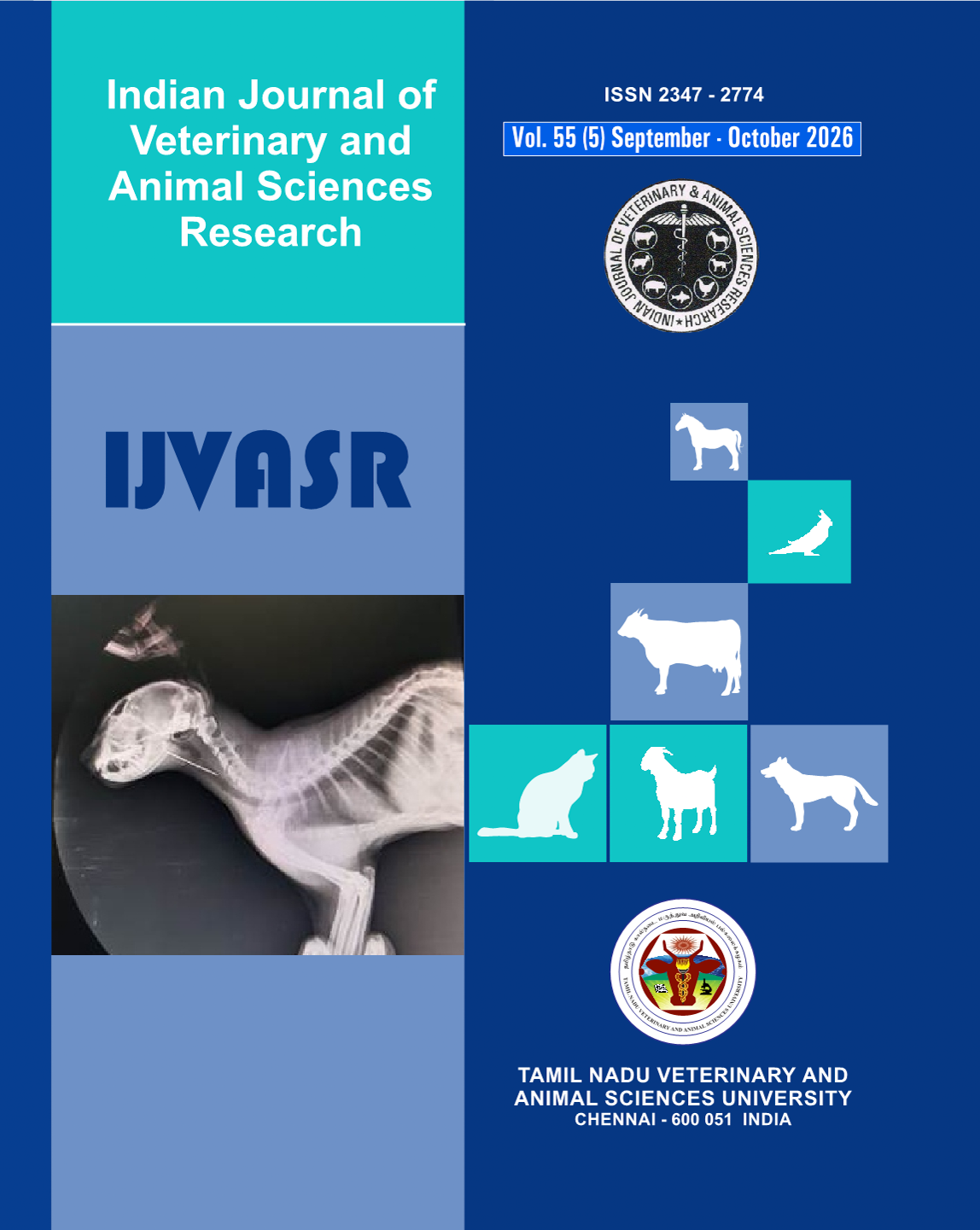
A six month old intact white female domestic short hair cat weighing 2 kgs was presented to the Veterinary Clinical Complex with a history of acute onset of repeated regurgitation, hypersalivation and anorexia for the past 24 hours. The animal showed progressive dysphagia and reluctance to consume both solid and liquid feed since the onset of clinical signs. Radiographic examination of head and neck revealed a linear radiopaque foreign body lodged within the cervical part of oesophagus. There was no evidence of pneumothorax, pleural effusion or mediastinal emphysema was observed on radiographic evaluation. Under fluoroscopic examination (C-arm) a distinct linear radiopaque foreign body was visualized within the cervical oesophagus extending longitudinally along the oesophageal lumen. Under xylazine (1mg/kg), ketamine (10mg/kg) and diazepam (0.5mg/kg) anaesthesia, a sewing needle was retrieved with the help of long grasping forceps under real time fluoroscopic examination. The cat recovered uneventfully after removal of the foreign body. The present case highlights the clinical utility of C-arm fluoroscopy as a minimally invasive, real time imaging modality for precise localization and safe retrieval of oesophageal linear foreign bodies in feline patients. Early diagnosis and minimally invasive intervention significantly improve prognosis and reduce morbidity associated with oesophageal foreign bodies in cats.
Downloads
References
Abd Elkader, N.A., Emam, I.A., Farghali, H.A. and Salem, N.Y. (2020). Oesophageal foreign bodies in cats: Clinical and anatomic findings. PLoS ONE, 15(6): e0233983.
Augusto, M., Pinho, M. and Jones, B. (2005). Chronic oesophageal foreign body in a cat. Journal of Feline Medicine and Surgery, 7(4): 251–256.
Gualtieri, M. (2001). Esophagoscopy. Veterinary Clinics of North America: Small Animal Practice, 31: 605–627.
Hayes, G. (2009). Gastrointestinal foreign bodies in dogs and cats : a retrospective study of 208 cases. Journal of Small Animal Practice, 50(11): 576–583.
Johnson, S.E. and Sherding, R.G. (2000). Diseases of the esophagus and disorders of s w a l l o w i n g . In: Birchard, S.J. and Sherding, R.G. (Eds.), Saunders Manual of Small Animal Practice, 2nd edn., WB Saunders, Philadelphia, pp. 727–744.
Kim, S.E., Park, Y.W., Ahn, J.S., Son, W.G., Jeong, M., Yoon, J. and Seo, K. (2011). C-arm fluoroscopy for the removal of an intraorbital foreign body in a cat. Journal of Feline Medicine and Surgery, 13(2): 112–115.
Papazoglou, L.G., Patsikas, M.N. and Rallis, T. (2003). Intestinal foreign bodies in dogs and cats. Compendium on Continuing Education for the Practicing Veterinarian, 25(11): 830–843.
Downloads
Submitted
Published
Issue
Section
License
All the copy right belongs to the sponsoring Organization, Tamil Nadu Veterinary and Animal Sciences University, Chennai - 51.
How to Cite


