Status of aquatic resources and their harvest from Someswari River in Northern Bangladesh
341 / 0
Authors
-
 Binay Kumar Chakraborty
-
Allu Venkata Madhuri
-
Arifa Khatun

Abstract
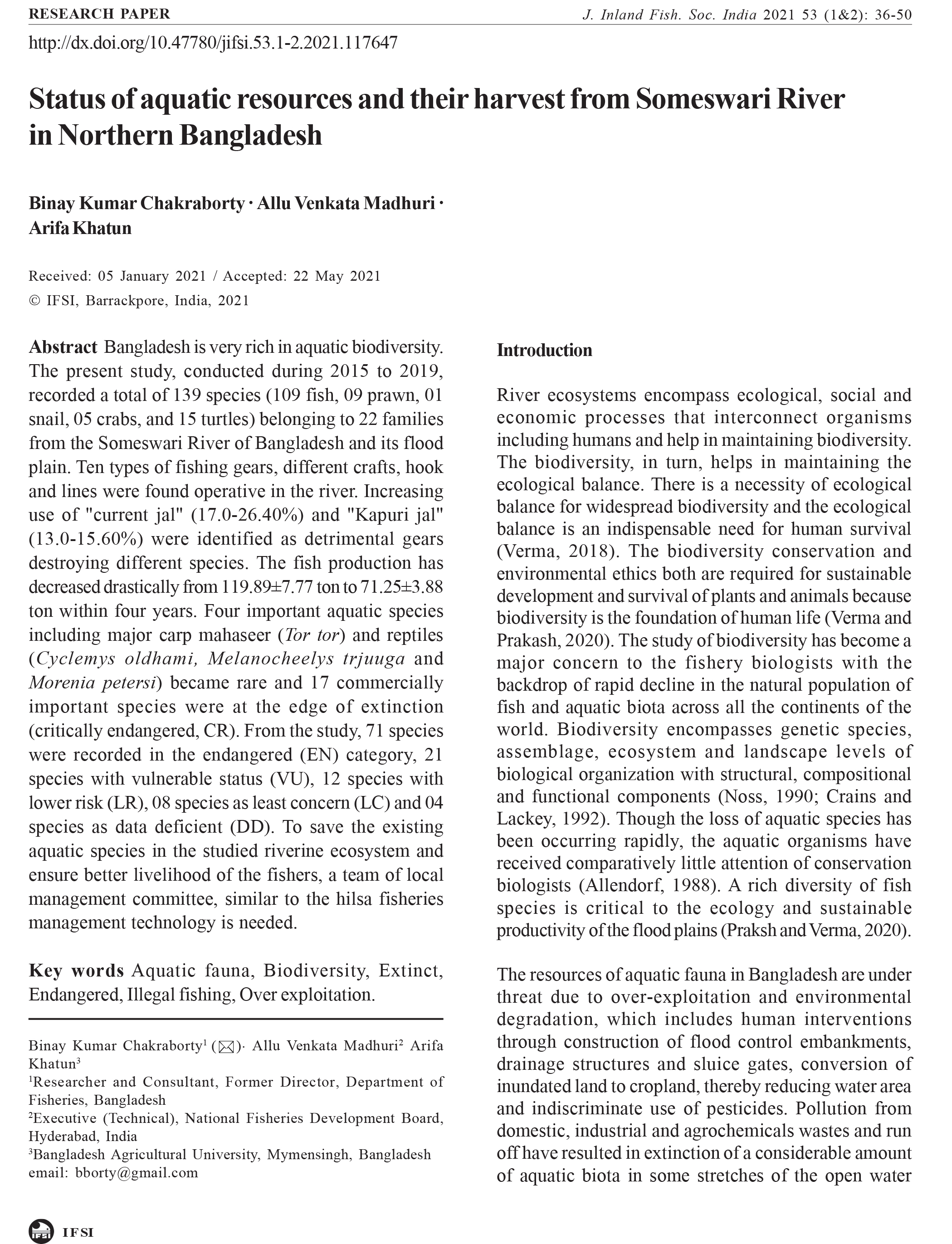
Bangladesh is very rich in aquatic biodiversity. The present study, conducted during 2015 to 2019, recorded a total of 139 species (109 fish, 09 prawn, 01 snail, 05 crabs, and 15 turtles) belonging to 22 families from the Someswari River of Bangladesh and its flood
plain. Ten types of fishing gears, different crafts, hook and lines were found operative in the river. Increasing use of "current jal" (17.0-26.40%) and "Kapuri jal" (13.0-15.60%) were identified as detrimental gears destroying different species. The fish production has decreased drastically from 119.89±7.77 ton to 71.25±3.88 ton within four years. Four important aquatic species including major carp mahaseer (Tor tor) and reptiles (Cyclemys oldhami, Melanocheelys trjuuga and Morenia petersi) became rare and 17 commercially important species were at the edge of extinction (critically endangered, CR). From the study, 71 species were recorded in the endangered (EN) category, 21 species with vulnerable status (VU), 12 species with lower risk (LR), 08 species as least concern (LC) and 04 species as data deficient (DD). To save the existing aquatic species in the studied riverine ecosystem and ensure better livelihood of the fishers, a team of local management committee, similar to the hilsa fisheries management technology is needed.
Key words Aquatic fauna, Biodiversity, Extinct, Endangered, Illegal fishing, Over exploitation.
References
APHA 1998. Standard methods for the examination of water and wastewater, 20th edition, American Public Health Association, Washington, DC.
Alam, A. K. M. K. 2004. The Someswari River (Bangladesh) response to active tectonics. Abstract Volume; 4th Nepal Geological Congress, Nepal Geological Society, Katmandu, 9-11 April, 2004, 25 p.
Alam, G. N. 1996. Floodplain fisheries development in Bangladesh. Fisheries News Bangladesh Fisheries Research Institute, 4(1): 3-4.
Allendrof, F. W. 1988. Conservation biology of fishes. Conservation Biology, 2: 145-148.
Ali, M. Y. 1991. Towards sustainable development: fisheries resources of Bangladesh International union for conservation of nature and natural resources. The World Conservation Union. National Conservation Strategy of Bangladesh and Bangladesh Agricultural Research Council. 96p.
Boyd, C. E. 1982. Water Quality Management for Pond Fish Culture. Elsevier, The Netherlands. 318p.
Chakraborty, B. K., Bhattacharjee, S. and Muniya, S. 2021. A Study of aquatic biodiversity of Shuthi-Shaiduli river of Bangladesh. International Journal of Biological Innovations, 3(1): 58-67.
Chakraborty, B. K., Shahroz, M. H., Bhuiyan, A. B., Bhattacharjee, S. and Chattoraj, S. 2019. Status of Indian major carps spawns in the Halda River along with marketing and economic condition of the Fishers and related collectors. International Journal of Biological Innovations, 1(2): 40-50. https://doi.org/ 10.46505/IJBI.2019.1202.
Chakraborty, B. K. 2011. Present Status of Biodiversity in Bogajan Beel in Northern Bangladesh. Journal of the Fisheries Society of Taiwan, 38(4): 277-300.
Chakraborty, B. K. and Mirza, M. J. A. 2010. Aquatic biodiversity of Someswari River in Bangladesh. Asian Fisheries Science, 23:174-193.
Chakraborty, B. K. 2009. Aquatic biodiversity of Someswari and Nethai River and Gharia and Nidaya Beel of Northern Bangladesh. In: Takumi K. Nakamura (ed.). Aquaculture Research Progress, Nova Science Publishers, New York, USA, pp.3231-3268.
Chakraborty, B. K. and Mirza, M. J. A. 2007. Study of aquatic biodiversity of Gharia Beel of Bangladesh. Journal of Crop and Weed, 3: 23-34.
Clesceri, L. S., Greenberg, A. E. and Trussell, R. R. 1989. Standard methods of the examination of water and wastewater (17th ed.). American Public Health Association, American Water Works Association and Water Pollution Control Federation, 1015 Washington
D. C., USA 20036, pp. 10-203.
Cairns, M. A. and Lackey R. T. 1992. Biodiversity and management of natural resources: The issues. Fisheries, 17(3): 6-10.
Das, I. 1991. Color guide to the turtles and tortoises of the Indian sub continent. R & A publishing Ltd. Disaster, E. 1990. Floodplain protection in Central Europe. World Wildlife Found (WWF) Institute of Floodplains Ecology Visiting Card 31/90, Germany.
Haroon, A. K. Y., Halder G. C. Rahman S. L. Razzaque M. A. Alam M. and Amin S. M. N. 2002. Sylhet-mymensingh basin fish stock assessment. Final Report. Bangladesh Fisheries Research Institute, Reverine Station, Chandpur, Bangladesh, 81p.
IUCN Bangladesh 1998. List of threatened animals of Bangladesh. Paper presented in the Special Workshop on Bangladesh Red Book of Threatened Animals, 22 February 1998, Dhaka, Bangladesh. 13p.
IUCN 2000. Red book of threatened fishes of Bangladesh. IUCN- The World Conservation Union xii+116 p.
Khan, H. R. 1993. Water development activities and their impacts on wetlands. pp. 23-32. In: A. Nisat, Z. Hossain, M. K. Roy, and Ansarul Karim (eds.). Freshwater wetlands in Bangladesh: issues and approaches for management. IUCN, Gland Switzerland. xii+283p.
Khan, M. A. R. 1982. Chelonians of Bangladesh and their
conservation. Journal of Bombay Natural History Society, 79 (i): 110-116.
Mathew, P. W. 1975. Limnology and productivity of Govindgarh Lake, Maddya Prodesh, India. Journal of the Inland Fisheries Society of India, 11: 16-24.
Mazid, M. A. 2002. Development of fisheries in Bangladesh: plans and strategic for income generation and poverty alleviation. Fisheries Research Institute, Mymensingh, Bangladesh. pp. 78-79.
Mazid, M. A. and Hossain, M. S. 1995. Development of fisheries resources in floodplains. FRI publication No. 12. Fisheries Research Institute, Mymensingh, Bangladesh.
Moyle, P. L. and Leidy, R. A. 1992. Loss of biodiversity in aquatic ecosystem: evidence from fish fauna. In: P.L. Fielder and H.L. Jani (eds). Conservation of Biology: the theory and practice of nature conservation, preservation and management. Chapman and Hall, New
York, USA. 562p.
Nishat, A. 1993. Freshwater wetlands in Bangladesh: status and issues. pp.9-22 In: A. Nishat Z. Hossain, M. K. Roy, and Ansarul Karim (eds.). Freshwater wetlands in Bangladesh: Issues and Approaches for management. IUCN, Gland Switzerland. xii+283p.
Noss, R. F. 1990. A regional landscape approach to maintain
diversity. Bioscience, 33: 700-706.
Prakash, S. and Verma A. K. 2020. Effect of Organophosphorus Pesticides on Biomolecules of Fresh Water Fish, Heteropneustes fossilis (Bloch). Indian Journal of Biology, 7(2):65-69.
Rahman, M. S. 1992. Water quality management in aquaculture.
BARC Prokashana, 66, Mohakhali, Dhaka 1212, Bangladesh 84 pp.
Sarker, S. U. 1993. Faunal diversity and their conservation in
freshwater wetlands. In Freshwater wetlands in Bangladesh issues and approaches for management.
IUCN, The world Conservation Union, pp.105-122.
Shannon, C. E. 1948. A mathematical theory of communication. Bell System Technical Journal, 27: 379- 656.
Sugunan, V. V. and Bhattacharya, B. K. 2000. Ecology and fisheries of beels in Assam. Bull.No.104, CIFRI, Barrackpore-743101, West Bengal 66 p.
Verma, A. K. 2018. Ecological Balance: An Indispensable Need for Human Survival. Journal of Experimental Zoology, India, 21 (1): 407-409
Verma, A. K. and Prakash, S. 2020. Status of Animal Phyla in different Kingdom Systems of Biological Classification.
International Journal of Biological Innovations, 2(2): 149 - 154. https://doi.org/ 10.46505/ IJBI.2020.2211
Zaman, S. M. H. 1993. Agricultural development and sustainability of wetlands. pp.63-178 In: A. Nishat Z. Hossain, M.K. Roy, and A. Karim (eds.). Freshwater wetlands in Bangladesh: Issues and Approaches for management. IUCN, Gland Switzerland. xii+283p.
Zar, J. H. 1984. Biostatistics. Prentice-Hall, Inc. Englewood Cliffs, New Jersey, USA. 718.
Downloads
Published
Issue
Section
License
Copyright (c) 2023 Journal of the Inland Fisheries Society of India

This work is licensed under a Creative Commons Attribution-NonCommercial-ShareAlike 4.0 International License.
In case of publication of the article in the journal, author(s) are required to assign copyright to the Journal of the Inland Fisheries Society of India for its publication in any form/language including all media (print and electronic, or presently unknown), and exclusive right to use the matter for the life of the work (no time restriction on re use of matter).