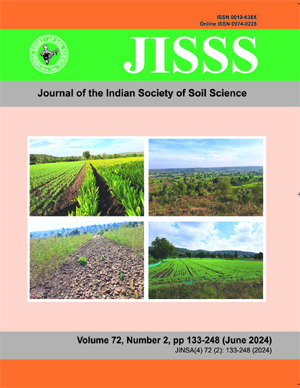
The Pedospheric Variation in Physicochemical Properties of Guava Growing Soils in North-East Haryana
476 / 128
Authors
-
 Dharam Pal
-
M.K. Sharma
-
R.S. Garhwal
-
Dinesh
Keywords:
Pedographic variation, physicochemical properties, bulk density, cation, anionAbstract
A profile study was conducted to evaluate the physicochemical properties of guava growing soils in northeast Haryana, by selecting fifteen guava orchards based on the variation in soils and guava dominance during the year 2021-2023. Water retention characteristics of different horizons in pedons were linked to the soil textural properties and with the increase in fineness of soil, water retention was found to increase significantly and vice-versa. Clay content was observed to have positive and significant correlation with moisture retention at different suctions, while sand was found negatively correlated with water retention characteristics of soil. Bulk density and penetration resistance of all the pedons were ranging from 1.31 to 1.63 Mg m-3 and 0.88 Mpa to 5.08 Mpa, respectively. The pH of guava growing soil of studied pedons was neutral to highly alkaline (7.05 to 8.71) in reaction. The soils have low electrical conductivity (EC) in the surface and as well as in sub-surface horizons with no definite trend and the organic carbon content was found to be low to high (0.14 to 0.83%) in all the pedons. Calcium emerged as dominating cation among others in all the studied pedons and the major cations followed the order Ca2+>Mg2+ > Na+> K+ throughout the profile, whereas, sulphate was dominant anion on the exchange complex amd they followed the order SO4 2->Cl- >HCO3->CO32-. The cation exchange capacity, exchangeable sodium percentage and base saturation percentage ranged from 3.80 to 36.70 cmol(p+)kg-1, 1.97 to 21.42 and 65.53 to 97.59%, respectively in all the pedons.
Downloads
Published
Issue
Section
License
The copyright of the articles published in Journal of the Indian Society of Soil Science vests with the Indian Society of Soil Science (ISSS), who has the right to enter into any agreement with any organization in India or abroad engaged in reprography, photocopying, storage and dissemination of information contained in these journals. The ISSS has no objection in using the material, provided the information is being utilized for academic purpose but not for commercial use. Due credit line should be given to the ISSS where information will be utilized.