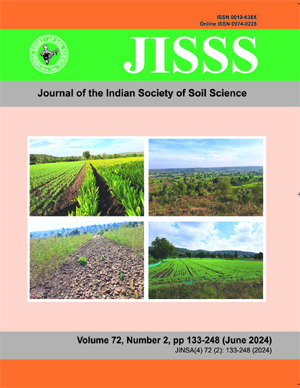
Characterization and Classification of Major Finger Millet (Eleusine coracana L.)-Growing Soils of Karnataka
362 / 52
Authors
-
 M. Nivetha
-
K.S. Anil Kumar
-
K.S. Karthika
-
V. Ramamurthy
-
H.C. Prakasha
-
Jagdish Prasad
Keywords:
Characterization, classification, Cation exchange capacity, finger milletAbstract
major finger millet (Eleusine coracana L.)-growing soils associated with isohyperthermic soil temperature regime. Four typifying pedons representing the agro-climatic zones viz., the Eastern dry zone (Sidlaghatta), the Central dry zone (Kadur), the Southern dry zone (Kunigal), and the Southern transition zone (Hunsur) were characterized and classified. The soils were generally redder, well-drained with sandy loam surface and non-gravelly or very gravelly clayey texture in soil family control section with weak to moderate subangular blocky structure. Soils were very strongly acid (pH 4.85) and low in soil organic carbon (OC 0.58%) in Sidlaghatta to neutral pH (6.88) and high OC (1.48%) at Hunsur. The cation exchange capacity (CEC) was found to increase down the profile with a CEC:clay ratio of low (0.12) at Sidlaghatta and high (0.80) at Hunsur site. The soils identified at family level of soil taxonomy are Clayey-skeletal, Kaolinitic, sub-active, Haplic Plinthustults (Sidlaghatta), Fine, mixed, sub-active, Kanhaplic Rhodustalfs (Kadur), Fine, mixed, active, Rhodic Paleustalfs (Kunigal) and Fine, mixed, super-active Vertic Haplustepts (Hunsur) and in the order of high to low degree of soil development. The finger-millet productivity (district average) recorded is in the order of Hunsur>Kadur>Kunigal>Sidlaghatta. Addressing the climate, land and soil related constraints can ensure highest production potential of the crop in Karnataka towards food and nutritional security.
Downloads
Published
Issue
Section
License
The copyright of the articles published in Journal of the Indian Society of Soil Science vests with the Indian Society of Soil Science (ISSS), who has the right to enter into any agreement with any organization in India or abroad engaged in reprography, photocopying, storage and dissemination of information contained in these journals. The ISSS has no objection in using the material, provided the information is being utilized for academic purpose but not for commercial use. Due credit line should be given to the ISSS where information will be utilized.