
ALTERNATION OF HEMATOLOGICAL AND SERUM BIOCHEMICAL PROFILES IN DOGS NATURALLY INFECTED WITH HEPATOZOON CANIS IN SOUTH WESTERN GUJARAT, INDIA
74 / 66
Authors
-
 B.R. Maharana
 Assistant Professor, Dept. of Veterinary Parasitology, College of Veterinary Science & A.H., JAU., Junagadh, Gujarat - 362 001,
-
Binod Kumar
Asst. Professor, Dept. of Veterinary Parasitology, College of Veterinary Science & A.H., JAU., Junagadh, Gujarat, 362001
-
B. J. Thakre
Asst. Professor, Teaching Veterinary Clinical complex, College of Veterinary Science & A.H., JAU., Junagadh, Gujarat, 362001
-
N. D. Hirani
Asst. Professor, Dept. of Veterinary Parasitology, College of Veterinary Science & A.H., JAU., Junagadh, Gujarat, 362001,
-
T. K. Patbandha
Polytechnic in Animal Husbandry, Junagadh (Gujarat)- 362001, India, JAU., Junagadh, Gujarat - 362 001

Keywords:
Biochemical, Dog, Hematological, Hepatozoon canis.Abstract
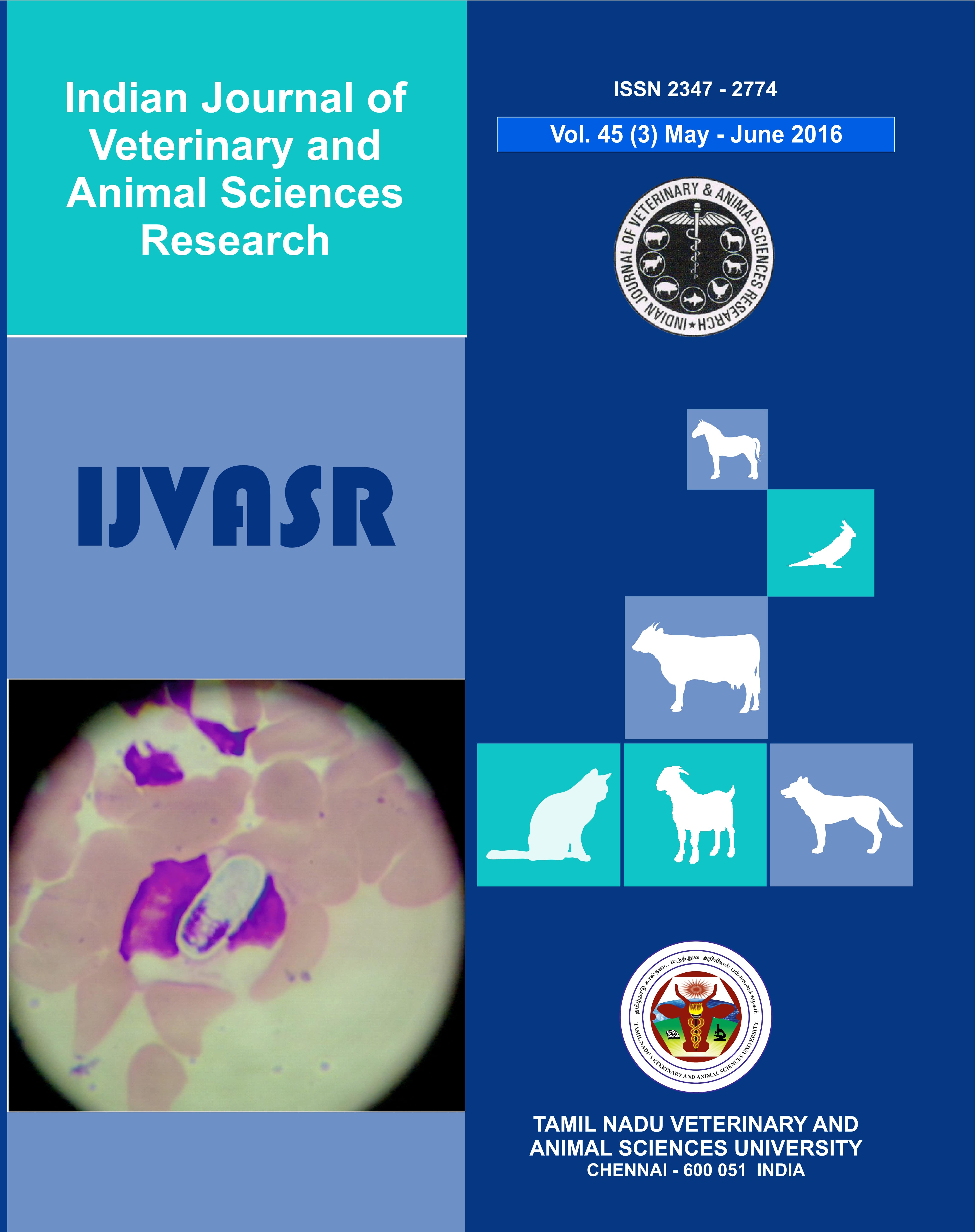
This study represents Hepatozoon canis infection in three among seventy eight dogs referred to Teaching Veterinary Clinical Complex (TVCC), Veterinary College, Junagadh from January to April 2013 with prior history of anorexia, anemia, depression and difficulty in locomotion. Significant clinical findings included higher body temperature (106oF), enlarged lymph nodes and congested mucus membrane. Blood smears were stained with Giemsa stain revealed capsule shaped gametocytes of H. canis in the cytoplasm of approximately 15 to 20% circulating neutrophils. This is the first time documentation of hepatozoonosis in dogs from south western Gujarat, India and hence placed on record.
Downloads
References
Banerjee, P.S., Mylonakis, M.E., Garg, R., Vatsya, S. and Yadav, C.L. (2008). Concurrent hepatozoonosis, monocytic and granulocytic ehrlichiosis in a dog. Journal of Veterinary Parasitology, 22: 9-11.
Baneth, G. (2001). Canine hepatozoonosis. In: Encyclopedia of Arthropod-transmitted infections of Man and Domesticated Animals. Ed M.W. service. CABI Publishing, Wallingford. pp 215-220.
Baneth, G. (2004.) Canine Hepatozoonosis - Two Different Diseases. Rhodes, Greece: 29th World Congress of the World Small Animal Veterinary Association.
Baneth, G. (2006). Hepatozoonosis. In: Infectious Diseases of the Dog and Cat, 3rd ed. (Greene, C. E. ed.), Saunders, Philadelphia. pp. 698 - 705.
Baneth, G., Aroch, I. and Presentey, B. (1997). Hepatozoon canis infection in a litter of Dalmatian dogs. Veterinary Parasitology,
:201-206.
Baneth, G., Harmelin, A. and Presentey, B.Z. (1995). Hepatozoon canis infection in two dogs. Journal of American Veterinary
Medical Association, 206:1891-1894.
Baneth, G., Mathew, J.S., Shkap, V., Macintire, D.K., Barta, J.R. and Ewing, S.A. (2003). Canine hepatozoonosis: two disease
syndromes caused by separate Hepatozoon species. Trends in Parasitology, 19: 27-31.
Barton, C.L., Russo, E. A., Craig, T.M. and Green, R.W. (1985). Canine hepatozoonosis: a retrospective study of 15 naturally occurring cases. Journal of American Animal Hospital Association, 21:125-134.
Chhabra, S., Uppal, S.K. and Singla, L.D. (2013). Retrospective study of clinical and hematological aspects associated with dogs naturally infected by Hepatozoon canis in Ludhiana, Punjab, India. Asian Pacific Journal of Tropical Biomedicine, 3(6): 483
Elias, E. and Homans, P.A. (2008). Hepatozoon canis infection in dogs: clinical and haematological findings; treatment. Journal
of Small Animal Practice, 29: 55-62.
Eljadar, M.S.M., Singla, L.D., Mustafa, R.A.A. and Uppal, S.K. (2012). Morphometric variations in gametocytes of Hepatozoon
canis from naturally infected dogs. Journal of Parasitic Disease, 37(1): 143-147.
Gaunt, S.D. (2000). Extreme neutrophillic leucocytosis. In: Schalm’s Veterinary Haematology. 5th Ed. Eds B.F. Feldman, J.G. Zinkel and N.C. Jain. Lippincott, Williams & Wilkins, Baltimore., Pg. 347-349.
Gondim, L.F.P., Kohayagawa, A., Alencar, N.X., Biondo, A.W., Takahira, R.K. and Franco, S.R. (1998). Canine hepatozoonosis in
Brazil: description of eight naturally occurring cases. Veterinary Parasitology, 74: 319-323.
James, S.P. (1905). On parasite found in the white corpuscules of the blood of dogs. Scientific Memoirs by the Officers of the Medical and Sanitary Departments of the Government of India, pg.1-12.
Kahn Cynthia, M. and Line, S. (2010). The Merck Veterinary Manual. 10th ed. Whitehouse Station, N.J., USA.
Kraft, W. and Durr, U.M. 1995. Klinische Labor diagnostic in der Tiermedizin. 3rd Ed. W. Kraft and U.M. Durr. Schattauer, Stuttgart.
Medici, E.M. and Heseltine, J. (2008). American canine hepatozoonosis. Compendium, 30: E1-E9.
Palanivel, K.M., Vijayalingam, and Selvasubramanian, S. (2010). Perspective T.A. studies on canine hepatozoonosis in Chennai. Science, 6: 291-293.
Pawar, S.D. and Gatne, M.L.(2005). Some haematological and biochemical profiles in canine hepatozoonosis. Journal of Veterinary Parasitology, 19: 171-172.
Pawar, S.D. and Gatne, M.L.(2004). Haematological and biochemical profiles in dogs infected with Hepatozoono canis. Journal of Veterinary Parasitology, 18: 185 -186.
Sakuma, M., Nakahara, Y., Suzuki, H., Uchimura, M., Sekiya, Z., Setoguchi, A. and Endo, Y. (2009). A case report: a dog with acute onset of Hepatozoon canis infection. The Journal of veterinary medical science, 71: 835-838.
Smi T.G. (1996). The genus Hepatozoon (Apicomplexa: Adeleina). Journal of Parasitology, 82: 565-585.
Downloads
Published
Issue
Section
License
All the copy right belongs to the sponsoring Organization, Tamil Nadu Veterinary and Animal Sciences University, Chennai - 51.
How to Cite


