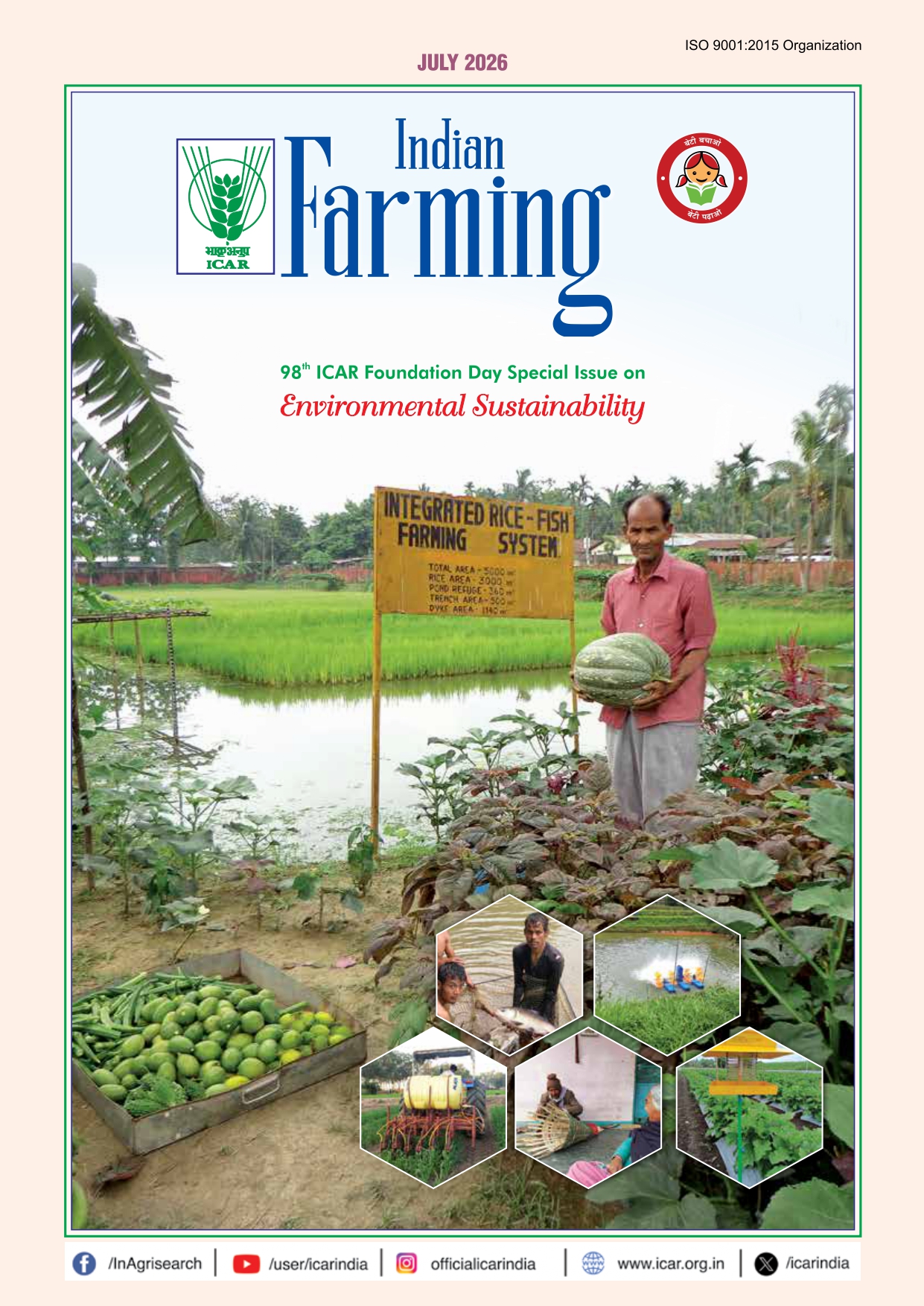
Aqua-village in Meghalaya: Linking science, community and sustainable livelihoods
151 / 177
Authors
-
 Chandan Debnath
 ICAR Research Complex for NEH Region, Umiam, Meghalaya 793 103
-
S. Gojendro Singh
ICAR Research Complex for NEH Region, Umiam, Meghalaya 793 103
-
Prasanta Mahanta
ICAR Research Complex for NEH Region, Umiam, Meghalaya 793 103
-
S. Ghatak
ICAR Research Complex for NEH Region, Umiam, Meghalaya 793 103
Keywords:
Composite fish culture, Integrated farming systems, North-eastern India, Sustainable rural livelihoods, Tribal aquacultureAbstract
Meghalaya's subsistence-level fish productivity of 1.5 t/ha/year continues unchanged despite the state's unique water resources endowment and traditional aquaculture practices. This article introduces the Aqua-village approach, a scalable, people-centric aquaculture development strategy tested in the Ri-Bhoi district as part of the ICAR-NEH Region's Tribal Sub-Plan (TSP). The approach combines composite fish farming practices with Indian Major Carps and exotic carps, scientifically designed pellet diets, paddle-wheel aeration systems, and livestock-pond synergies to realise production targets of 3–4 t/ha/year. Value addition and processing expertise are also incorporated to provide secondary livelihood opportunities, especially for women and youth. The Aqua-village approach is founded on knowledge-sharing for development, with synergies across several UN-SDGs, providing a sustainable model for tribal fisheries development in north-eastern India.
Downloads
Downloads
Published
Issue
Section
License
Copyright (c) 2026 Indian Farming

This work is licensed under a Creative Commons Attribution-NonCommercial-NoDerivatives 4.0 International License.
Complete copyright vests with the Indian Council of Agricultural Research, who will have the right to enter into an agreement with any organization in India or abroad engaged in reprography, photocopying, storage and dissemination of information contained in it, and neither author nor his/her legal heirs will have any claims on royalty.


