Accounting for nutrition and dietary diversity in an integrated organic and natural farming system
0 / 0
Authors
-
 M. Shamim
 ICAR-Indian Institute of Farming Systems Research, Modipuram, Meerut, Uttar Pradesh 250 110
-
N. Ravisankar
ICAR-Indian Institute of Farming Systems Research, Modipuram, Meerut, Uttar Pradesh 250 110
-
Namrata Jain
Jawaharlal Nehru Krishi Vishwa Vidyalaya, Jabalpur, Madhya Pradesh 482 004
-
Gopal Kumar
International Water Management Institute, New Delhi 110 012
Keywords:
Biodiversity, Livelihood security, Soil health, Water productivityAbstract
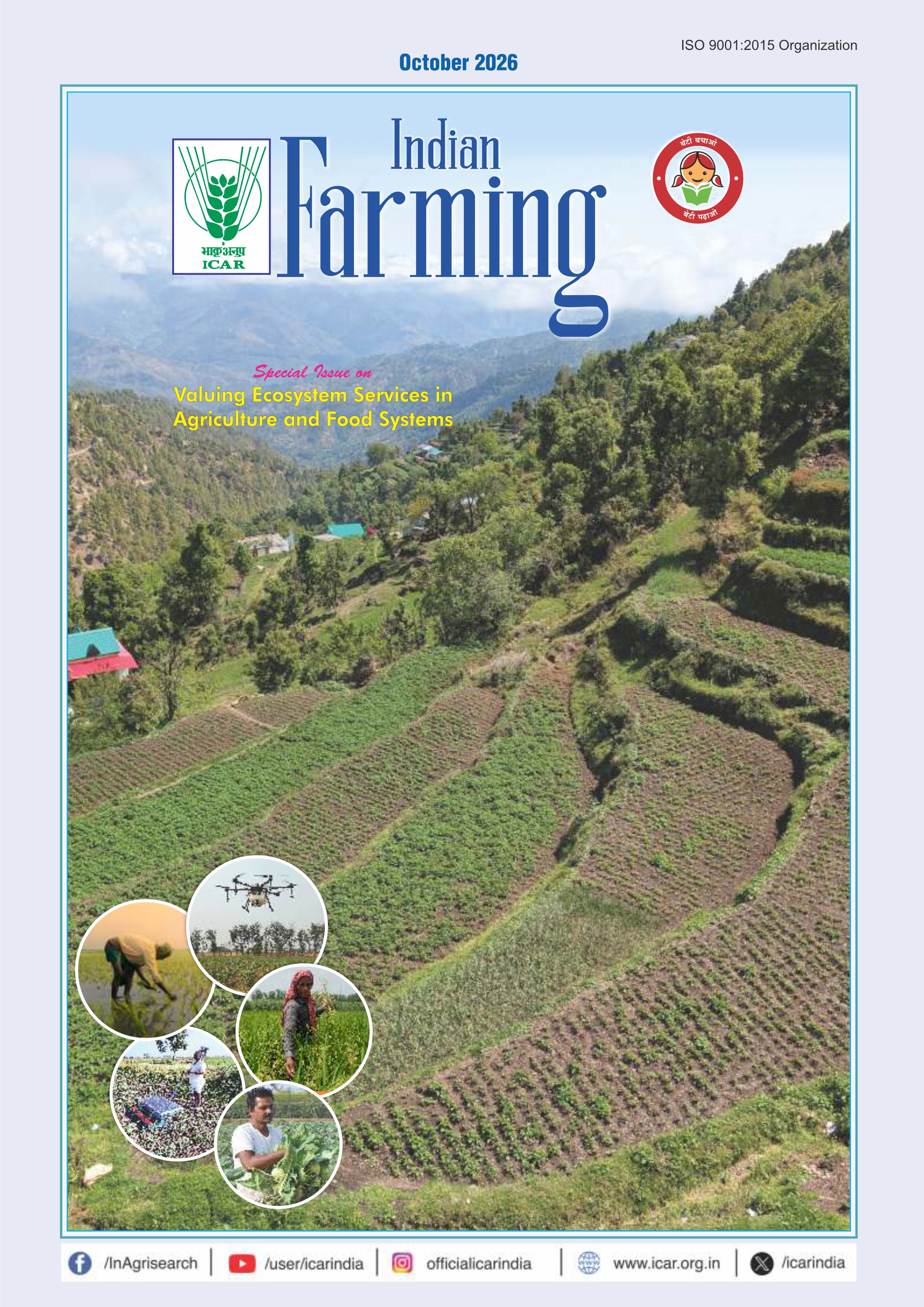
This article highlights how integrated organic and natural farming can provide Indian farmers with a practical approach to improve soil health, farm profitability, resource-use efficiency and livelihood resilience. The main innovation is to look beyond crop yield and income by considering soil biodiversity, water productivity, pesticide use, nutrition and dietary diversity as interconnected benefits of a diversified farming system. Integration of crops with livestock, poultry, dairy, horticulture, fisheries and other enterprises can provide farmers with multiple sources of food and income throughout the year, reduce seasonal dependence on a single crop and strengthen
household food and nutritional security. Recycling of crop residues, livestock wastes and other farm resources can improve soil fertility and reduce dependence on purchased inputs. Overall, diversified integrated farming offers a farmer-friendly pathway for making Indian agriculture more sustainable, resource-efficient, economically viable and better able to support food, nutrition and livelihood security.
Downloads
Downloads
Published
Issue
Section
License
Copyright (c) 2026 Indian Farming

This work is licensed under a Creative Commons Attribution-NonCommercial-NoDerivatives 4.0 International License.
Complete copyright vests with the Indian Council of Agricultural Research, who will have the right to enter into an agreement with any organization in India or abroad engaged in reprography, photocopying, storage and dissemination of information contained in it, and neither author nor his/her legal heirs will have any claims on royalty.